Highway Rainwater Harvesting
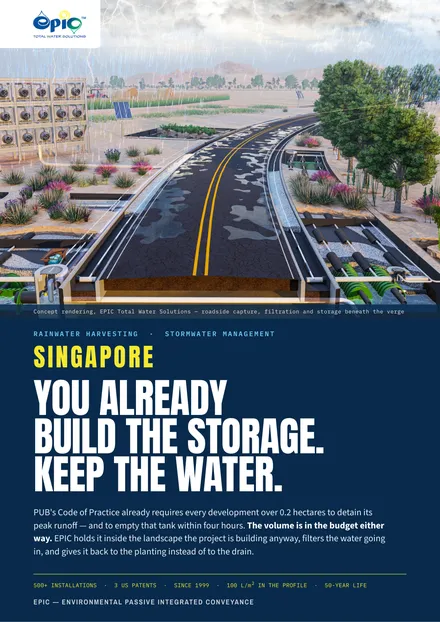
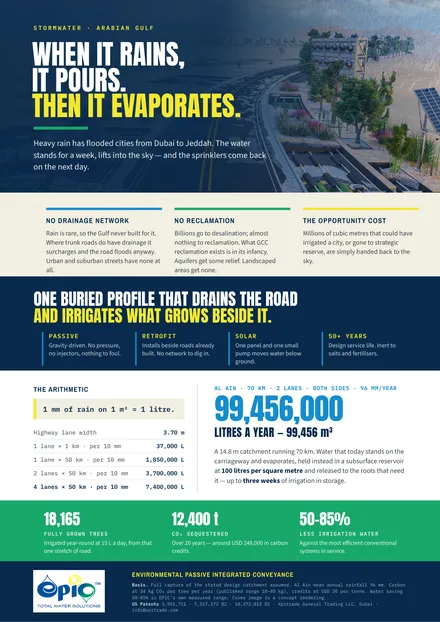
Taking road runoff into the subsurface profile instead of into a drain.
Open1 page

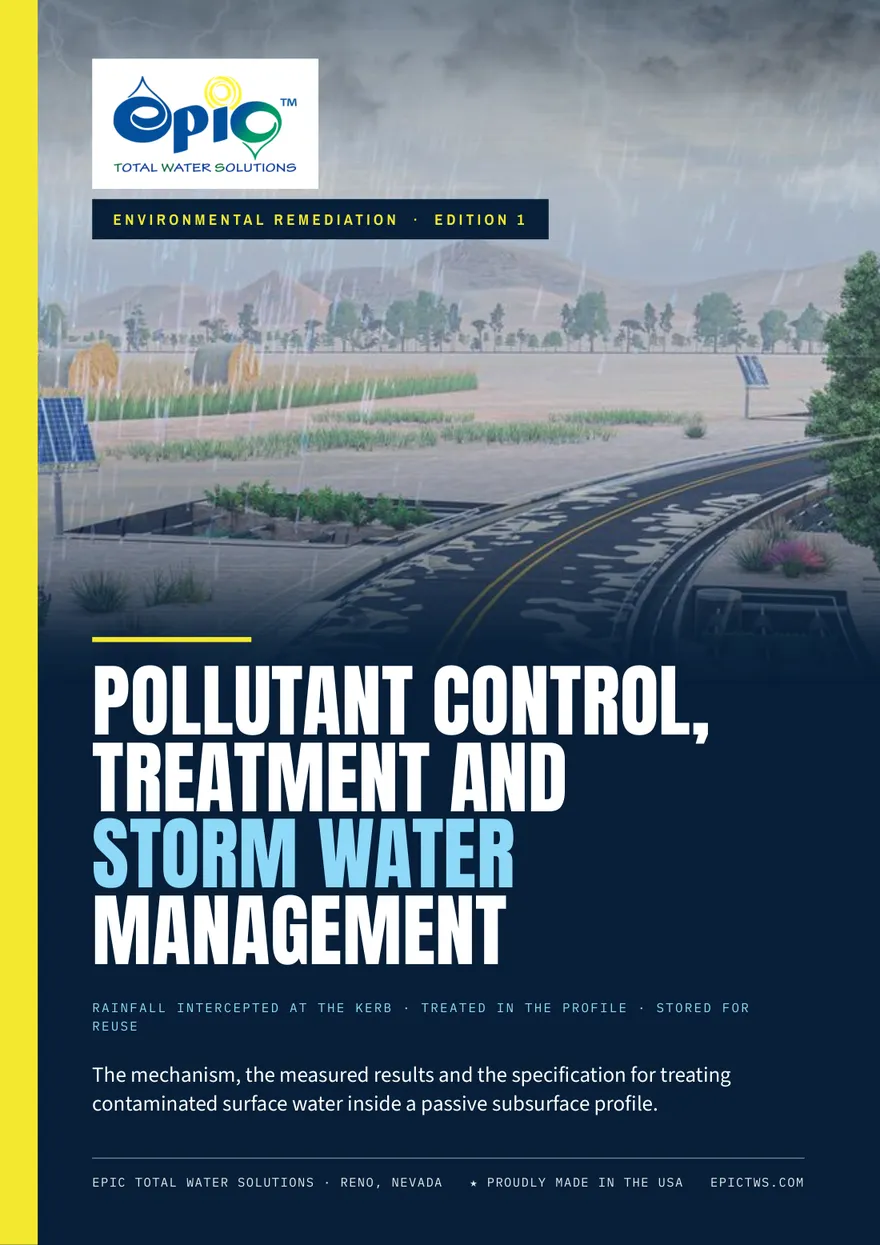
Applications & Markets · Environmental remediation
Pollutant control, treatment and storm water management: the mechanism, the measured results and the specification for treating contaminated surface water inside a passive subsurface profile.
This document sets out how an EPIC profile intercepts rainfall close to where it lands, treats it in the profile and stores it for reuse, so that one buried structure carries drainage, treatment, storage and irrigation, duties conventional practice buys as four separate pieces of infrastructure.
It is written for drainage and civil engineers, landscape architects, environmental consultants and municipal planners specifying storm water treatment, on-site wastewater dispersal or contaminated-ground capping. Part 01 describes the inherited problem: three categories of pollutant, drainage built for movement rather than management, the conventional inlet, first-generation BMPs, the detention basin and the straw wattle.
Part 02 explains the chemistry that decides the design, including the different behaviour of nitrate and phosphate. Part 03 sets out the EPIC principle: growing media, detention and treatment capacity, the chamber and its gravity trap, operating levels and the oil line. Part 04 describes the road filter for roads, industrial paved areas and other hardscapes, including the transfer filter at the kerb, and Part 05 applies the same geometry to wastewater and the leach field.
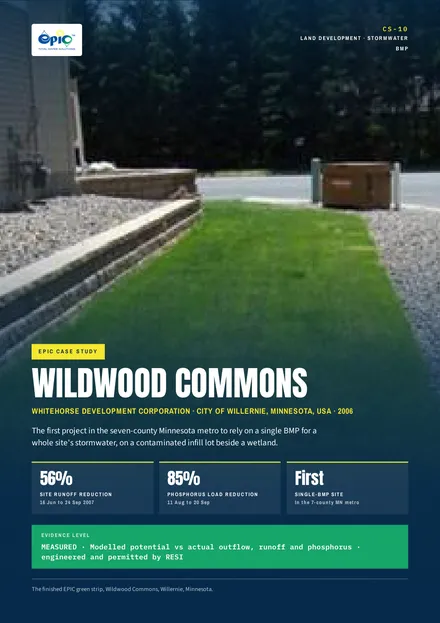
Part 06 presents the evidence from two installations engineered and approved by third parties, the Nevada Department of Transportation SR-28 project at Incline Village above Lake Tahoe and the Wildwood Commons brownfield redevelopment in Willernie, Minnesota. It closes with a comparison against the detention pond, a configuration selection table, design values and sources.
Taking road runoff into the subsurface profile instead of into a drain.
Open1 page
Stormwater source control against PUB Code of Practice clause 7.1.5, compared with tanks, bioretention, swales and porous paving.
Open8 pages
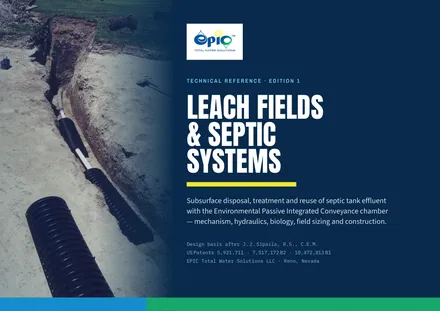
The technical reference for on-site wastewater and leach-line replacement.
Registered62 pages
Working on a project? Send us the drawings, the bill of quantities or the question.
Talk to usPublished by EPIC Total Water Solutions LLC, Reno, Nevada. Issued in the Middle East and North Africa by Xpitrade General Trading LLC.