Edition 1
Environmental Remediation
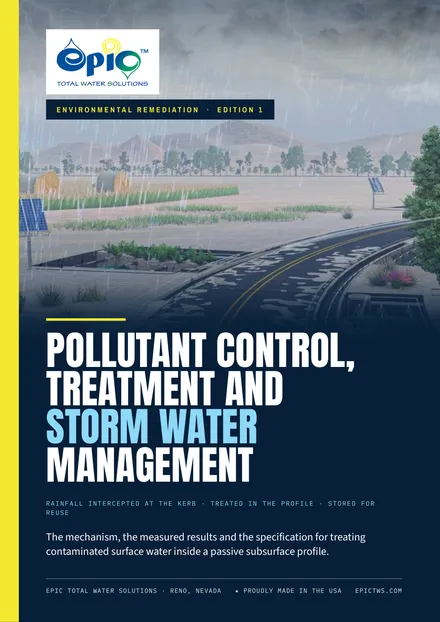
Mechanism, measured results and specification for treating contaminated surface water.
On request54 pages

Applications & Markets · One-page brief
A one-page brief on taking Gulf road runoff into a buried EPIC profile beside the carriageway, where it drains the road and irrigates what grows beside it.
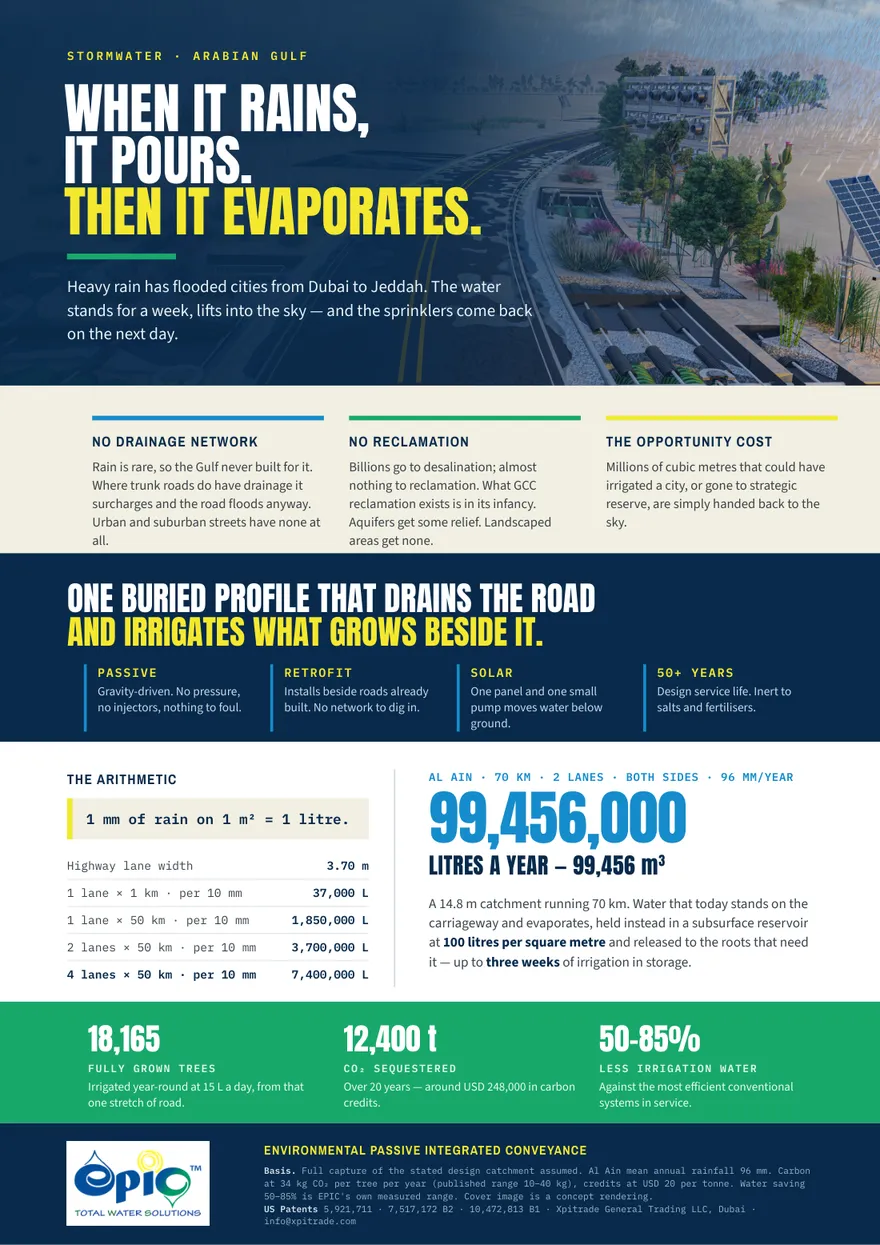
Heavy rain floods Gulf cities from Dubai to Jeddah, stands for a week and evaporates, and then the sprinklers come back on. This one-page brief sets out the case for holding road runoff in a buried EPIC profile beside the carriageway and releasing it to the roots instead.
The sheet names three gaps: no drainage network on most urban and suburban streets, very little reclamation, and the opportunity cost of runoff handed back to the sky. It describes the EPIC profile as passive and gravity-driven, suited to retrofit beside roads already built, able to run on one solar panel and one small pump, and designed for a service life of 50 years or more.
The arithmetic starts from 1 litre per m² for every millimetre of rain and a 3.70 m lane width. The worked case is 70 km of two-lane road at Al Ain, captured on both sides at a mean annual rainfall of 96 mm: a 14.8 m catchment yielding 99,456 m³ a year, stored at 100 litres per m² and enough to irrigate 18,165 fully grown trees at 15 litres a day.
The sheet states its basis: full capture of the design catchment, carbon at 34 kg CO₂ per tree per year, credits at USD 20 per tonne, and a water saving of 50 to 85% taken from EPIC's own measured range. The cover image is a concept rendering.
Mechanism, measured results and specification for treating contaminated surface water.
On request54 pages
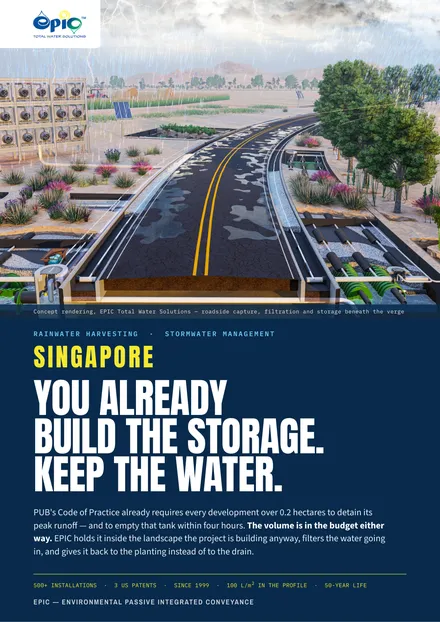
Stormwater source control against PUB Code of Practice clause 7.1.5, compared with tanks, bioretention, swales and porous paving.
Open8 pages
Every application, from irrigation and stormwater to greywater, blackwater and bioremediation, with accepted water sources and design notes.
On request75 pages
Working on a project? Send us the drawings, the bill of quantities or the question.
Talk to usPublished by EPIC Total Water Solutions LLC, Reno, Nevada. Issued in the Middle East and North Africa by Xpitrade General Trading LLC.