Edition 1
EPIC and Blackwater
Treating blackwater within the profile: the capability, the evidence and the limits.
On request24 pages

Applications & Markets · Technical reference
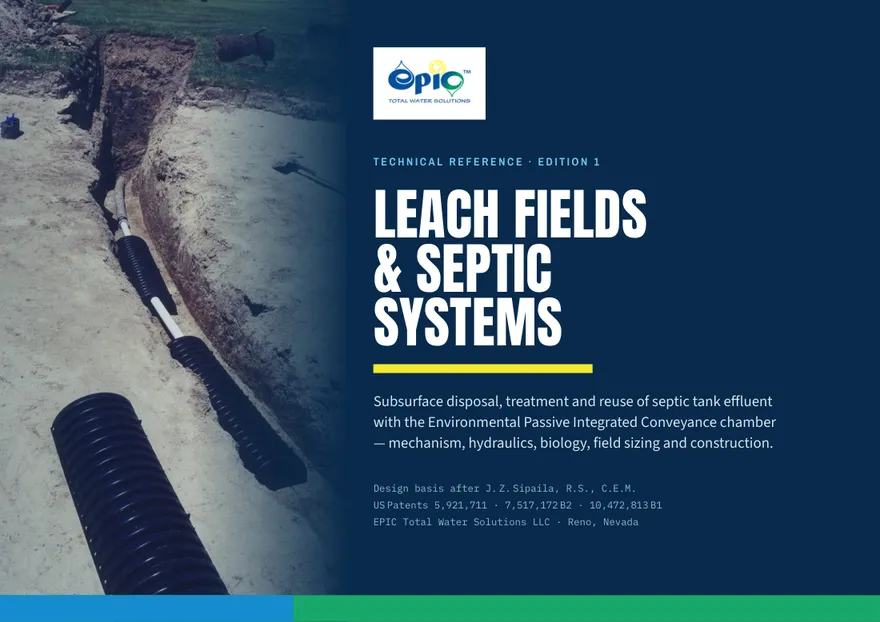
The engineering basis for disposing of, treating and reusing domestic wastewater in a shallow, sand-enveloped EPIC leach line, and the procedure for sizing one.
This technical reference covers the secondary stage of an on-site wastewater system, the disposal field, built as an EPIC leach line: an open-bottomed, double-walled chamber surrounded by washed sand and set on the compacted trench floor in place of the conventional stone trench and perforated pipe.
It is organised around three questions that govern every on-site field: how much liquid can leave the structure each day, how long that rate is sustained, and where the dissolved nitrogen goes. Parts I to III give the physical and biological answers: why a conventional stone field fails, how the EPIC leach line is configured, and the biology and chemistry of septic tank effluent in the profile.
Part IV turns those answers into a sizing procedure, with the design basis, soil interface geometry, sizing tables, worked examples and the EPIC percolation test. Part V covers the three configurations and how to choose between them, field alternation through a leachate switching vault, tree-pit blackwater irrigation, the sand filter, grey-water separation and estate layouts. Part VI covers installation, setbacks, commissioning, operation, comparative performance and the field record.
The design basis follows the work of Jonas Z. Sipaila, inventor of the EPIC chamber, and uses the United States Public Health Service percolation bands. The document states that application rates, setbacks and field areas are set by the health authority with jurisdiction, and that nothing in it overrides a local code. An annex of thirteen full-size plates is laid out for printing and site use.
Treating blackwater within the profile: the capability, the evidence and the limits.
On request24 pages
Mechanism, measured results and specification for treating contaminated surface water.
On request54 pages
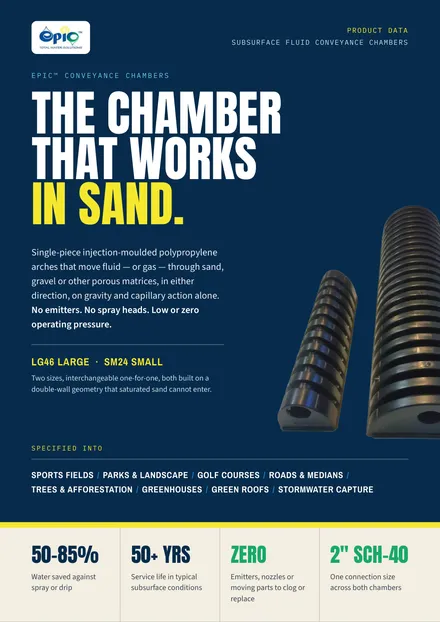
Acceptance criteria, grading envelope and the column test that qualifies a candidate sand.
On request26 pages
Working on a project? Send us the drawings, the bill of quantities or the question.
Talk to usPublished by EPIC Total Water Solutions LLC, Reno, Nevada. Issued in the Middle East and North Africa by Xpitrade General Trading LLC.