
Applications & Markets · Scientific white paper
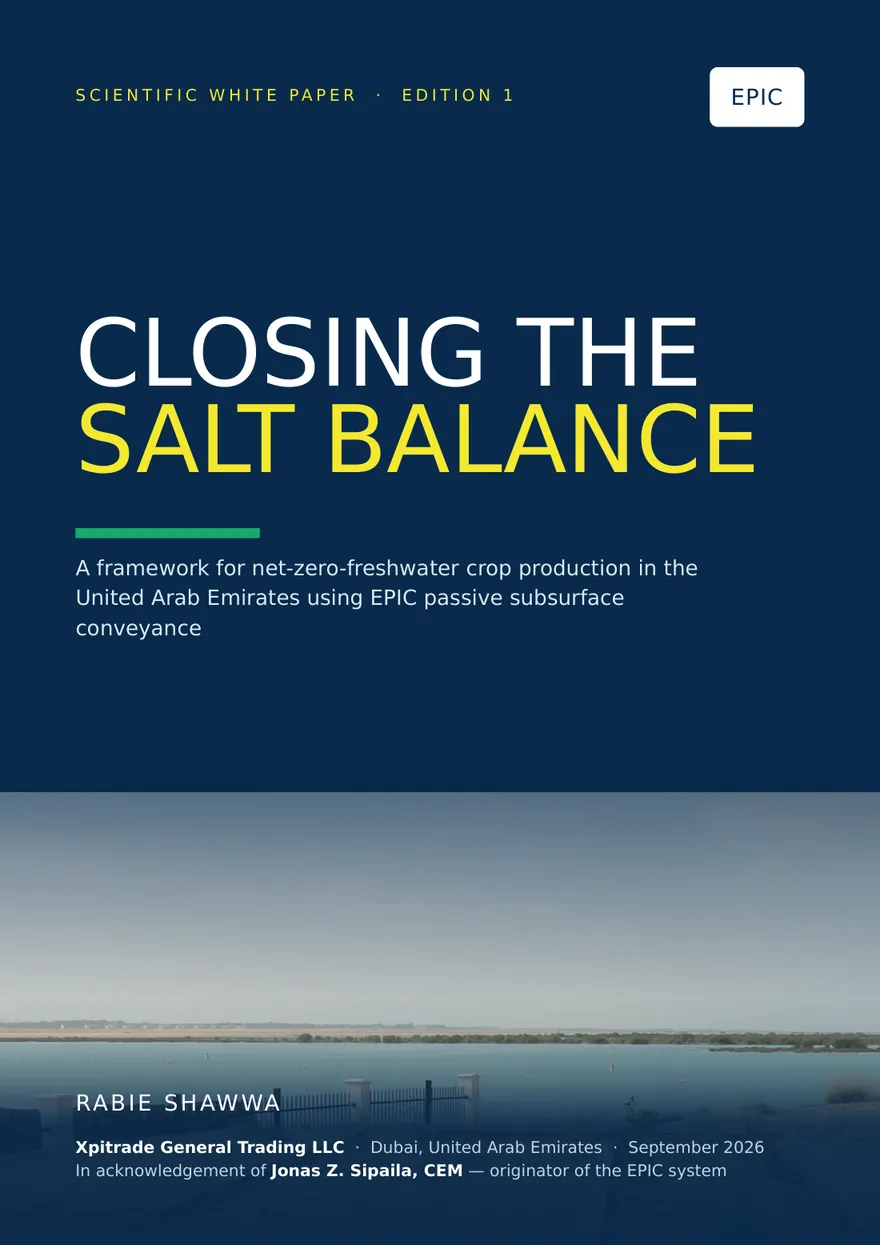
Closing the Salt Balance
A scientific white paper setting out a framework for net-zero-freshwater crop production in the United Arab Emirates using EPIC passive subsurface conveyance and saline water.
- Author
- Rabie Shawwa, Xpitrade General Trading LLC
- Edition
- 1 · September 2026
- Format
- PDF · 106 pages · 9.1 MB
- Access
- On request
About this document
Closing the Salt Balance examines what happens to salt when crops in the Emirates are irrigated through EPIC with desalination reject, saline groundwater, treated sewage effluent or, on the coast, seawater, and closes the salt mass balance around the resulting cell.
The paper acknowledges Jonas Z. Sipaila, originator of the EPIC system, and reproduces and re-reads the January 2009 column study he ran. It keeps measured, published and derived values visibly distinct, gives the equations behind every derived table so a reader can reproduce them, and names the quantities that remain unknown, assigning each one to an experiment.
Ten stated findings lead into eight parts. These cover the water problem in the Emirates, the mechanism by which the profile handles salt (including the Yas Island records of 2011 and 2012), the mass-balance design method, the complementary technologies ranked by leverage, and five crop pathways: halophyte oilseed, halophyte lignocellulose, halophytic forage grasses, salt-tolerant grain and coastal planting.
The later parts set out a staged demonstration programme of seven case studies, each with its instrument list, pass or fail criterion and the decision it unlocks, followed by the risks, the limits and the results that would falsify the thesis. Five appendices reproduce the 2009 laboratory dataset and the Yas Island records, and give the design equations, salt tolerance reference data and unit conventions.
What is inside
- FrontAcknowledgement, abstract and findingsThe debt to the EPIC originator, the paper in summary, and ten findings with their section references.
- Part 1The problem worth solvingWater in the Emirates, why saline irrigation fails, the forage question, brine as a resource, and what net zero water can mean.
- Part 2The mechanismThe profile and chamber, the inverted gradient, the January 2009 column study, the Yas Island records and sodicity in sand.
- Part 3Closing the balanceThe mass-balance identity, leaching requirement, cycles of concentration, the gypsum ceiling, the design rule and a worked module.
- Part 4The complementary technologiesReservoir chemistry, electrodialysis on the bleed, solar evaporation, atmospheric water, enclosures, biology, instrumentation and energy.
- Part 5Five crop pathwaysHalophyte oilseed, halophyte lignocellulose, halophytic grasses, salt-tolerant grain and coastal planting, compared and ranked.
- Part 6The demonstration programmeSeven case studies from the Salt Balance Cell to the Coastal Ecosystem Cell, with schedule, gates and partners.
- Part 7Risk, limits and falsificationFailure modes, what would falsify the thesis, environmental and regulatory questions, and what is and is not claimed.
- Part 8ConclusionThe answer to the question the paper set out to address, with its qualifications.
- A to EReferences and appendicesThe 2009 dataset, Yas Island records, design equations, salt tolerance data, and units and precision.
Read it with
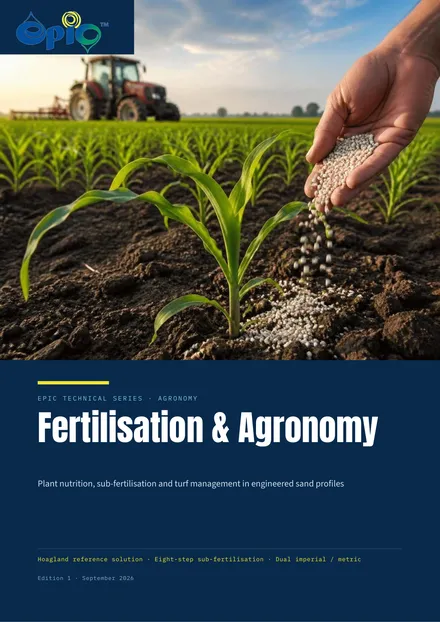
Fertilisation & Agronomy
Subsurface fertilisation, the nutrient regime and turf management under EPIC.
Registered44 pages
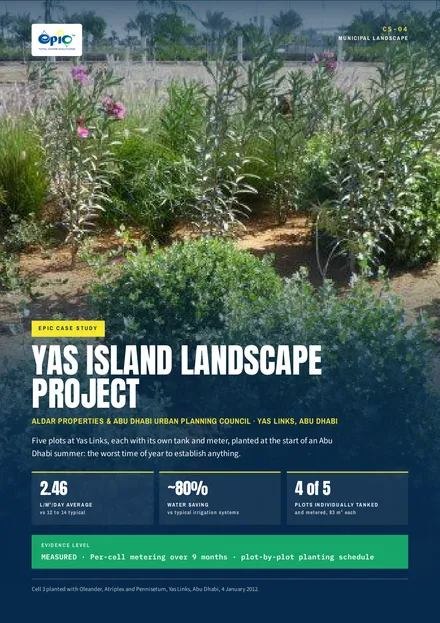
Yas Island Landscape Project
Yas Links, Abu Dhabi, United Arab Emirates
Open6 pages
Working on a project? Send us the drawings, the bill of quantities or the question.
Talk to usPublished by EPIC Total Water Solutions LLC, Reno, Nevada. Issued in the Middle East and North Africa by Xpitrade General Trading LLC.