Edition 1
Closing the Salt Balance
White paper: net-zero-freshwater crop production in the UAE using saline water.
On request106 pages

Project case study · CS-05 · Saline water · Research
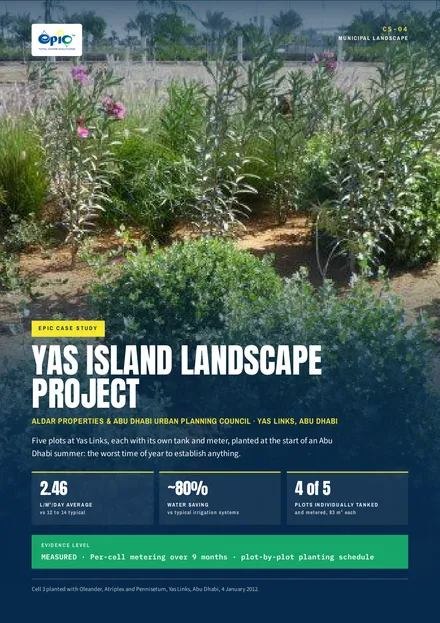
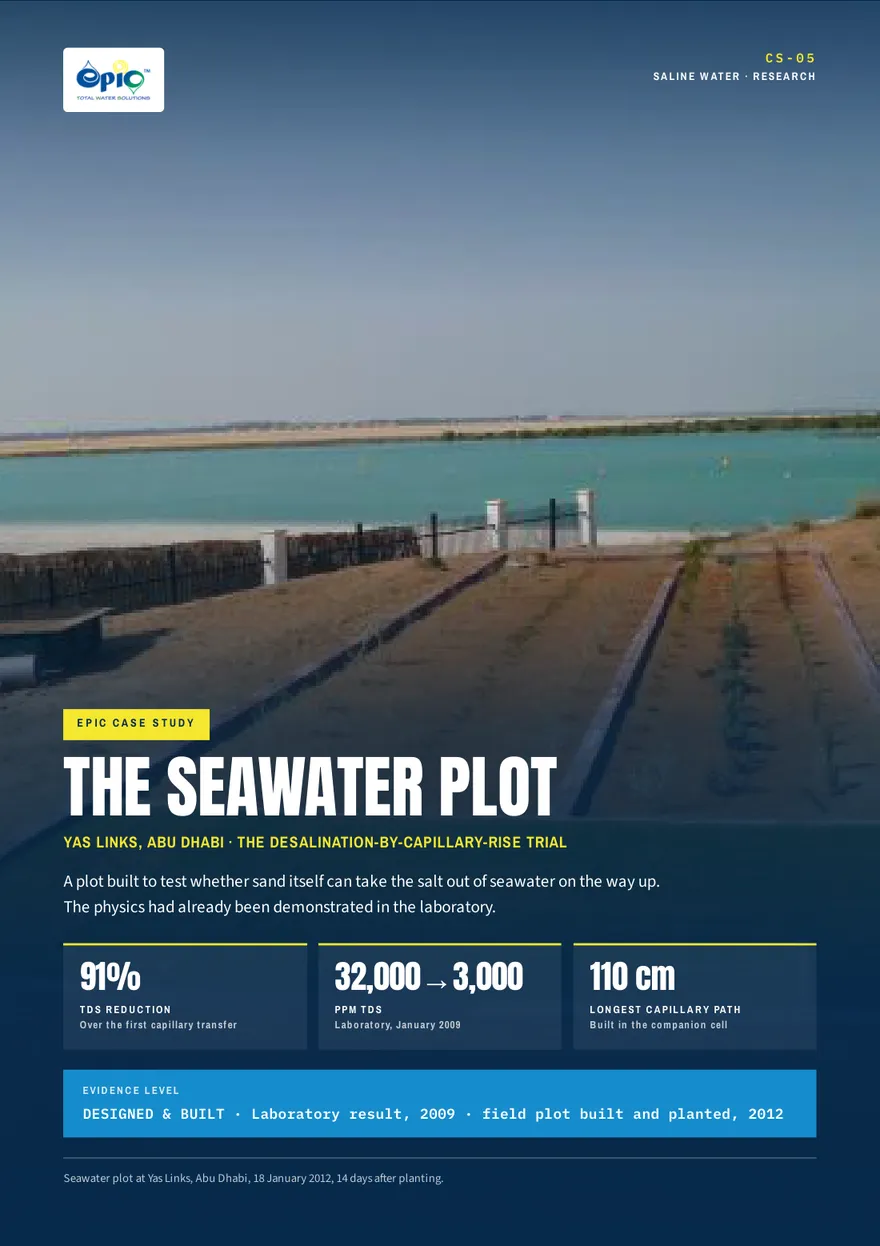
Yas Links, Abu Dhabi · The desalination-by-capillary-rise trial. A plot built to test whether sand can take salt out of seawater as the water rises through it, after the physics had been shown in the laboratory.
A two-cell seawater plot at Yas Links, Abu Dhabi, planted on 4 January 2012. It tests whether salt water moving up through sand by capillary action separates out its dissolved ions, and whether any effect depends on how far the water travels.
A solar-operated pump feeds seawater into the EPIC cell. The water loops through the chambers and returns to the sea, leaving a saturated zone 75 mm deep. From there, water can reach the surface only by rising through the sand: 50 cm in the first cell. In the companion cell it must climb a 40 cm barrier wall, go down the other side and rise again, up to 110 cm in all.
For its first two weeks the plot was watered with fresh water. It was then hardened on a mix of TSE and seawater, and the plan recorded on 29 January 2012 was to phase out the TSE over four weeks. Planting included Sesuvium portulacastrum, Atriplex, Conocarpus, Pennisetum, Paspalum turf and date palm. A full sampling protocol sets out laboratory analysis for TDS, sodium, calcium, magnesium, chloride and potassium.
The laboratory basis is the inventor's January 2009 study. Salt water at 32,000 ppm TDS fell to 3,000 ppm over the first capillary transfer, a 91% reduction, with no significant further change over the next two transfers. The inventor suggests two possible mechanisms. The tight water film in the capillary zone may squeeze out larger molecules like a membrane, or denser seawater may stratify below the lighter water. Because the reduction stops after the first transfer, the application is specified for salt-tolerant species.
White paper: net-zero-freshwater crop production in the UAE using saline water.
On request106 pages
Yas Links, Abu Dhabi, United Arab Emirates
Open6 pages
Every application, from irrigation and stormwater to greywater, blackwater and bioremediation, with accepted water sources and design notes.
On request75 pages
Working on a project? Send us the drawings, the bill of quantities or the question.
Talk to usPublished by EPIC Total Water Solutions LLC, Reno, Nevada. Issued in the Middle East and North Africa by Xpitrade General Trading LLC.