Edition 1
Leach Fields & Septic Systems
The technical reference for on-site wastewater and leach-line replacement.
Registered62 pages

Applications & Markets · Capability document
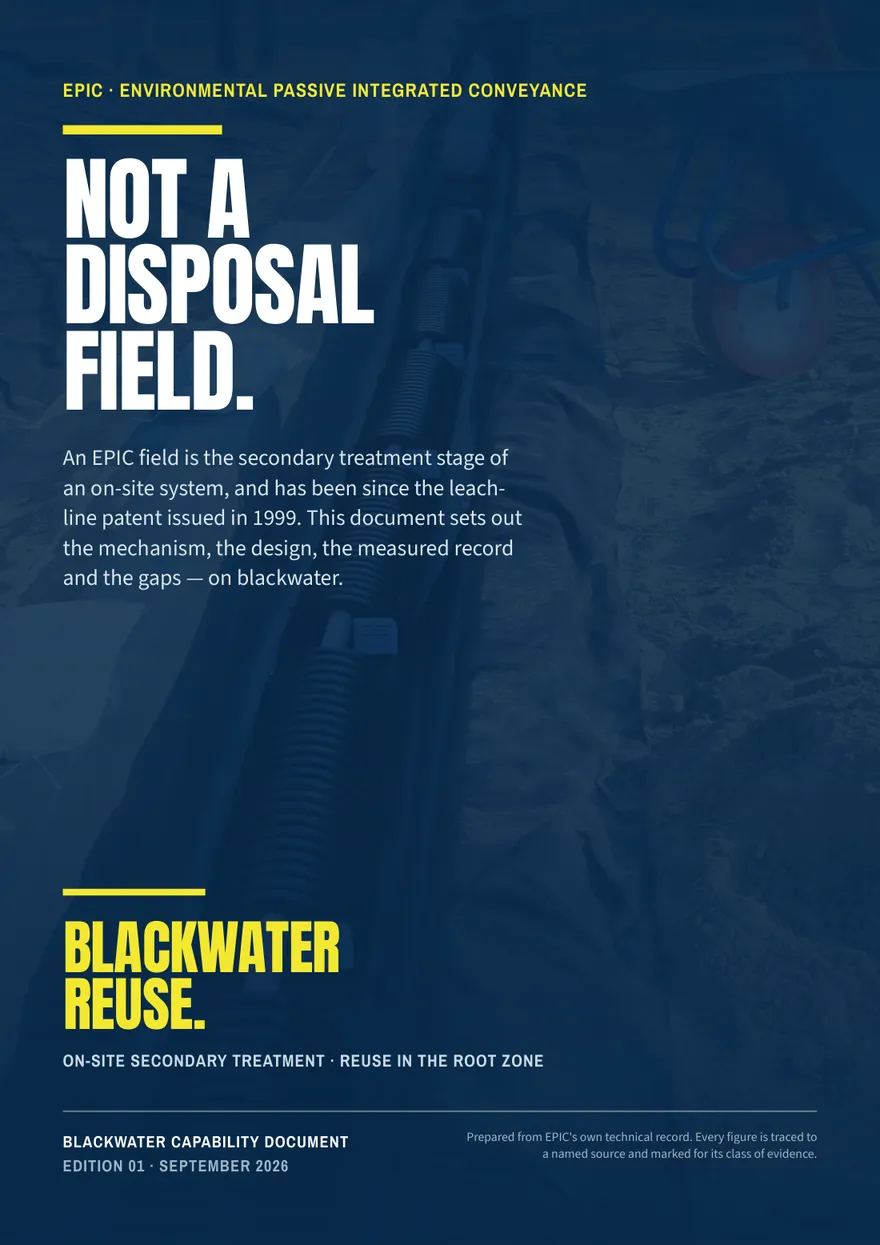
The capability document for EPIC as the secondary treatment stage of an on-site wastewater system: the mechanism, the design, the record and the open questions.
EPIC and Blackwater takes as its starting point EPIC's own statement that a septic tank is primary treatment and the field that follows it is the secondary stage, and sets out how an EPIC cell is designed to perform that role.
The document is arranged in nine parts. It opens with why a stone-filled leach line fails and why filter area matters more than storage volume, then describes the EPIC growth cell, the character of septic tank effluent, nitrogen, solids and pathogens, and what has and has not been measured, with the comparison basis stated for each result.
The design parts cover sizing from a percolation test, three design families (unlined, panned and EPDM-lined), the values carried on EPIC's 2022 construction drawings, and field alternation through a switching box. Later parts describe the tree cell and other configurations, the feedwater EPIC accepts, the approval route with regulators, and the measurements a pilot installation would need to make.
Every figure is marked by class of evidence: R for a measured result, D for a design figure and S for a sourced statement of mechanism or practice. The document is written so an engineer or reviewer can see what is settled and what is not, and it states that it is not a permit, not a water-quality guarantee and not a substitute for a percolation test on the actual site.
The technical reference for on-site wastewater and leach-line replacement.
Registered62 pages
Mechanism, measured results and specification for treating contaminated surface water.
On request54 pages
Every application, from irrigation and stormwater to greywater, blackwater and bioremediation, with accepted water sources and design notes.
On request75 pages
Working on a project? Send us the drawings, the bill of quantities or the question.
Talk to usPublished by EPIC Total Water Solutions LLC, Reno, Nevada. Issued in the Middle East and North Africa by Xpitrade General Trading LLC.