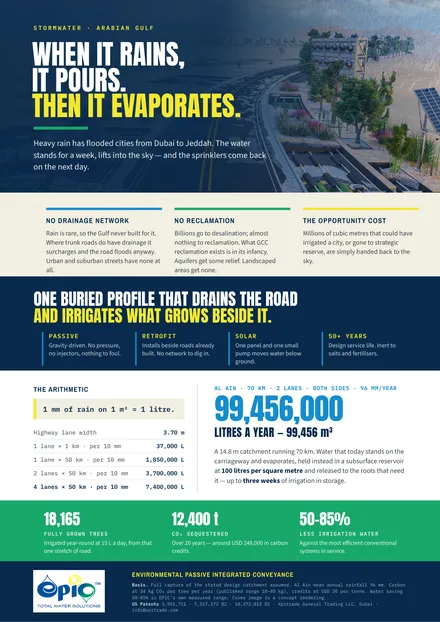
Highway Rainwater Harvesting
Taking road runoff into the subsurface profile instead of into a drain.
Open1 page

Project case study · CS-08 · Urban stormwater · Municipal
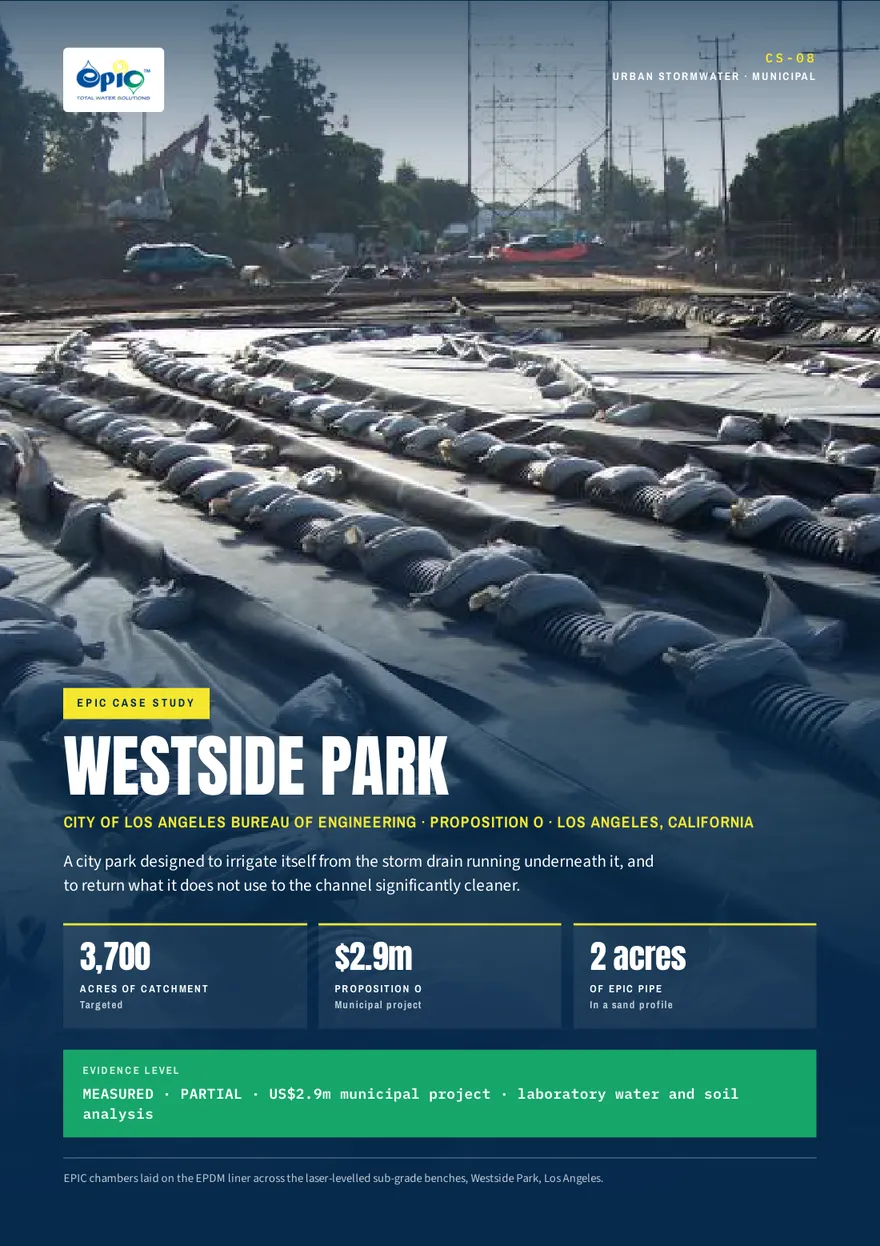
City of Los Angeles Bureau of Engineering · Proposition O · Los Angeles, California. A city park designed to irrigate itself from the storm drain running underneath it, and to send the water it does not use back to the channel much cleaner.
A US$2.9 million Proposition O project for the City of Los Angeles Bureau of Engineering. A city park takes its irrigation water from the drainage channel that runs beneath it. The project targets runoff from 3,700 acres beside South Fairfax Avenue, which drains to Ballona Creek and Santa Monica Bay.
Flow in the channel is intercepted and partly diverted to a pump lift station. The water is screened for floating waste and heavy sediment, then fed to a two-acre network of EPIC pipes in 13 in of sand over 2 in of gravel. When channel flow exceeds the park's demand, normal drainage carries on. The system is unpressurised and runs by gravity. It is laid in 15 sections of 300 to 500 ft on laser-levelled benches that follow the park's slope, each with one inlet and one outlet.
The chambers sit on Firestone EPDM liner with all sides folded up to hold water in cells. Moisture reaches the surface by capillary action along a winding flow path from high ground to low. Excess filtered stormwater is stored in underground chambers and, once they are full, is designed to discharge towards a dry creek and back into the storm drain. An existing tree was kept, with its root mass buried to finished grade and watered by capillary movement over the liner wall.
Wallace Laboratories analysed soil and water samples taken on 24 August 2011. The soil is sand with pH 7.77, and roots were 4 to 5 in deep at two months. The September 2011 site report found the pump lift station running non-stop, so the profile never rested and breathed. It recommended a 36-hour irrigation cycle once a week, noting that roots grow beyond 10 in when a profile is cycled correctly. The report concluded that the stormwater can be used for irrigation, with extra fertiliser needed.
Taking road runoff into the subsurface profile instead of into a drain.
Open1 page
Stormwater source control against PUB Code of Practice clause 7.1.5, compared with tanks, bioretention, swales and porous paving.
Open8 pages
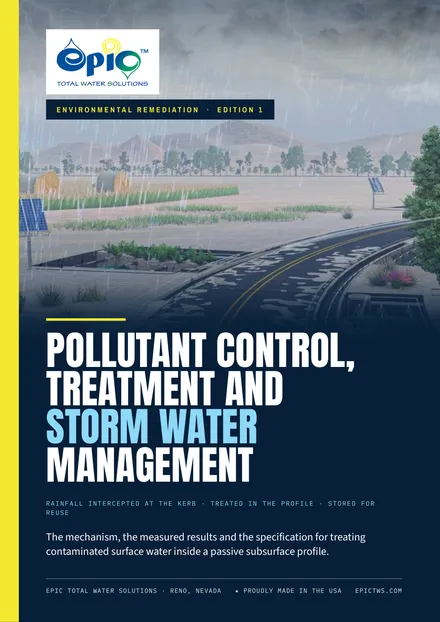
Mechanism, measured results and specification for treating contaminated surface water.
On request54 pages
Working on a project? Send us the drawings, the bill of quantities or the question.
Talk to usPublished by EPIC Total Water Solutions LLC, Reno, Nevada. Issued in the Middle East and North Africa by Xpitrade General Trading LLC.