Developer Brief · Edition 1
LEED & GCC Rating Systems
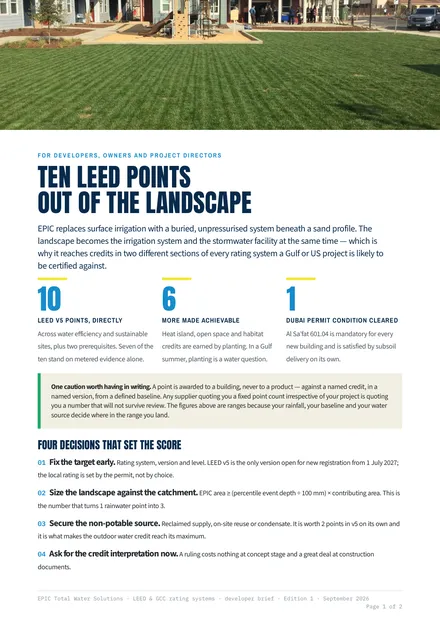
The two-page version, for a developer deciding early in a scheme.
Open2 pages

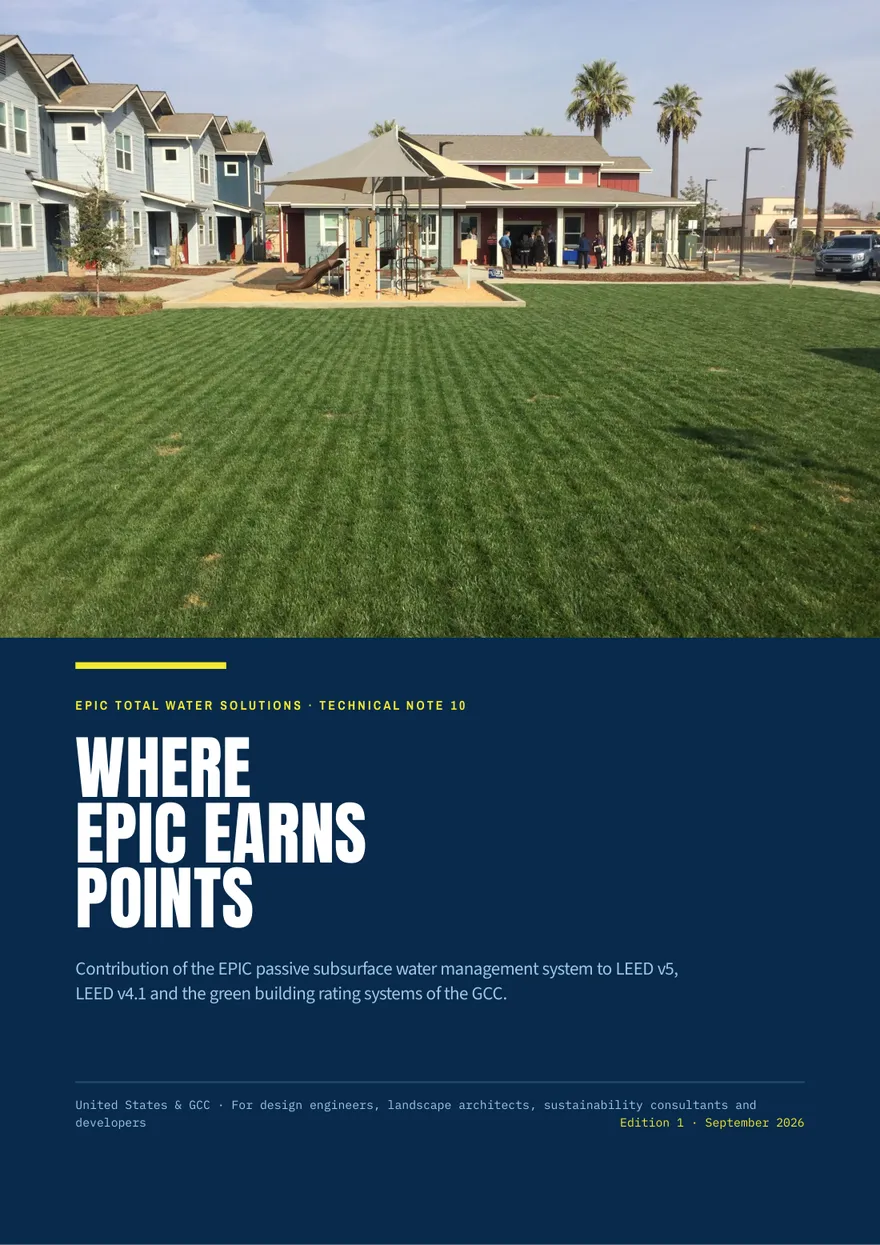
Performance & Compliance · Technical Note 10
Which credits EPIC reaches under LEED v5, LEED v4.1 and the GCC rating systems, what it contributes to each, what the project team must still do, and what evidence EPIC provides.
An eleven-page mapping of the EPIC passive subsurface system against LEED v5, LEED v4.1, Al Sa'fat, Estidama, Mostadam and GSAS, written for design engineers, landscape architects, sustainability consultants and developers in the United States and the GCC. It is a mapping document, not a certification opinion.
Every credit is classed as Direct, Enabling, Prereq or No claim. On a LEED v5 BD+C new construction project the guide maps 7 to 10 direct points across WE c2 Enhanced Water Efficiency (Option 4, Outdoor Water Use, and Option 6, Water Reuse), WE c1 Water Metering and Leak Detection, SS c3 Rainwater Management and SS c4 Enhanced Resilient Site Design, plus the prerequisites WE p1 and WE p2. Six more points are enabled through SS c5 Heat Island Reduction, SS c2 Accessible Outdoor Space, SS c1 Biodiverse Habitat and PR c1 Project Priorities.
The v4.1 map covers WE p1 and WE c1 Outdoor Water Use Reduction, WE c4 Water Metering, SS c4 Rainwater Management and the enabling site credits, with the transition dates between versions. For the Gulf, the guide covers Al Sa'fat Regulation 601.04 Water Efficient Irrigation, which a subsoil delivery system satisfies on its own; the Estidama Pearl Building, Community, Villa and Public Realm systems; Mostadam W-02 Outdoor Water Performance; the Saudi treated sewage effluent regulations; and GSAS W.1 Water Demand Performance and W.2 Water Reuse Performance.
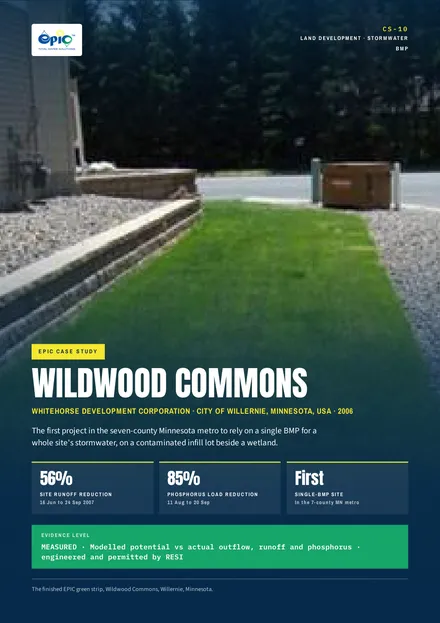
Metered irrigation savings are shown against the comparator each was measured against, alongside stormwater and runoff-quality records from Wildwood Commons, Westside Park and SR-28 at Lake Tahoe. The guide also states where EPIC makes no claim (Materials and Resources, Energy and Atmosphere, groundwater recharge through a lined cell and carbon neutrality), and closes with the submittal table, five questions a reviewer will ask and the open items on the product file.
The two-page version, for a developer deciding early in a scheme.
Open2 pages
The approvals and standards register: what EPIC is tested and certified against.
On request9 pages
Working on a project? Send us the drawings, the bill of quantities or the question.
Talk to usPublished by EPIC Total Water Solutions LLC, Reno, Nevada. Issued in the Middle East and North Africa by Xpitrade General Trading LLC.