Technology Overview
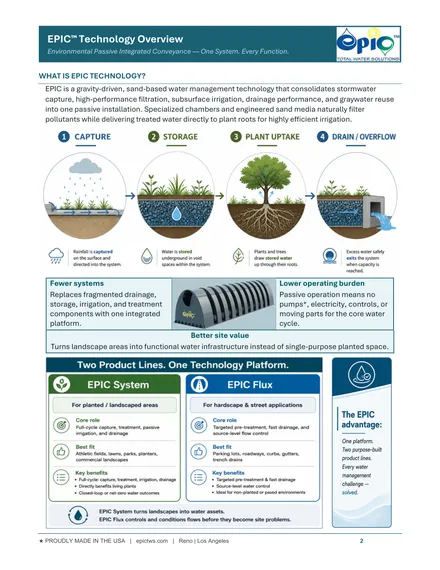
The two-page technology description. The short form for a first conversation.
Open2 pages

Start Here · Technical reference
The complete reference for the EPIC subsurface water-management system in four parts and 34 questions: what it is, what it is made of, how it works in the ground and what happens to it at the end of its life.
EPIC is a sealed, gravity-driven basin built below ground that irrigates from below by capillary rise, drains from above by infiltration, filters what passes through it and stores what it captures, with no emitters, spray, pressure lines or moving parts inside the growing area.
The guide is arranged as 34 questions in four parts, each written to be read on its own. Part I sets out what the system is and what it does without being told to. Part II covers the components: the two chamber types and their patents, the 45-mil EPDM liner, the gravel and the qualified sand. Part III covers the physics, the layer stack, the design rules, the installation sequence with its four hold points, and operation. Part IV covers materials, end of life and applications.
Three terms are used precisely throughout: the EPIC Chamber, the moulded polypropylene arch; the EPIC Cell, one lined basin and everything inside it; and the EPIC Profile, the whole assembly from subgrade to planted surface. A specification snapshot lists the values that do not change, including chamber rows at 2.0 m centres, chambers at 0.9 m along the row, a 75 mm design standing-water depth and a tolerance of ±13 mm across the cell floor.
It is written for developers, consulting and irrigation engineers, landscape architects, contractors, and sustainability and procurement teams. A closing table of verified numbers gives each headline figure with its source, from the University of Nevada, Reno field statistics of 2000 to 15 months of monitored operation on blended desalination reject at 6,000 to 7,000 ppm TDS.
The two-page technology description. The short form for a first conversation.
Open2 pages
The complete question-and-answer reference, checked against the Technical Series.
On request56 pages
Site evaluation, materials, components, cell design, hydraulics, agronomy, drawing production and the standard details library.
On request161 pages
Working on a project? Send us the drawings, the bill of quantities or the question.
Talk to usPublished by EPIC Total Water Solutions LLC, Reno, Nevada. Issued in the Middle East and North Africa by Xpitrade General Trading LLC.