
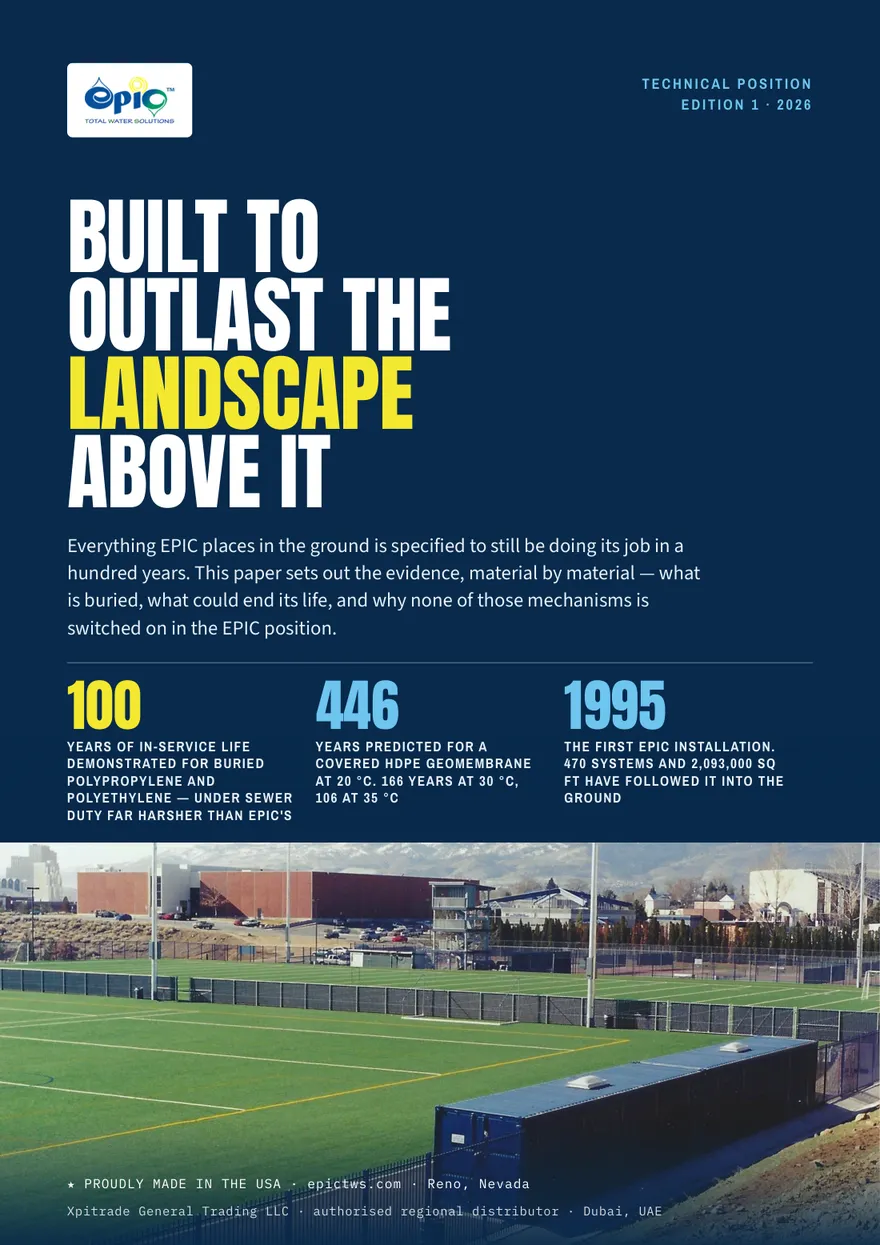
Performance & Compliance · Technical position
Service Life of the Buried System
The evidence, material by material, for the position that everything EPIC places in the ground is specified to still be doing its job in a hundred years.
- Edition
- 1 · 2026
- Format
- PDF · 8 pages · 2.4 MB
- Access
- Open
About this document
An EPIC cell is a sequence of layers rather than a machine, and this eight-page paper takes the service-life question one material at a time: what is buried, what could end its life, and why those mechanisms are not active in the EPIC position.
Around 99% of the installed mass is sand, gravel and water, which has no degradation mechanism. For the polymer fraction, the paper sets out five ways a polymer fails (photo-oxidation, thermo-oxidation, sustained stress, chemical attack and biological attack) and explains why burial under 175 to 200 mm of sand removes ultraviolet exposure and damps temperature, leaving temperature as the only variable.
The chamber evidence rests on the December 2014 TEPPFA study with Borealis and LyondellBasell, which excavated polyolefin sewer pipe from five European sites after 12 to 38 years in service and concluded an in-service life of at least 100 years. The liner evidence draws on the Geosynthetic Institute's lifetime predictions for covered HDPE geomembrane, Queen's University incubation work and exhumed liners, and explains why EPIC specifies 1.14 mm EPDM to ASTM D7465 and does not accept PVC as an equal.
The paper also states where the claim stops: pumps, valves, float switches and controllers have indicative lives of 5 to 15 years and sit above ground or in accessible vaults. It separates the commercial warranty from the engineering service life, names aeration with core removal as the one maintenance item that matters, and closes with seven clauses that carry the service-life conditions into a project specification.
What is inside
- Part 1Nine layers, four materialsThe EPIC profile layer by layer, and the share of installed mass in each class of material.
- Part 2How polymers failFive degradation mechanisms and the position of each in a buried EPIC profile.
- Part 3The chambersThe TEPPFA hundred-year finding for buried polyolefins, why EPIC's duty is easier, and the 2009 independent load testing.
- Part 4The linerPredicted and exhumed geomembrane lifetimes, and why EPDM is specified rather than PVC.
- Part 5Sand and the recordWhy the mineral profile does not decompose, and installations in the ground since 1995.
- Part 6Where the claim stopsComponents with shorter indicative lives, the one maintenance item, and warranty against service life.
- Part 7Specifying itSeven specification clauses that carry the service-life conditions onto a project, with sources.
Read it with
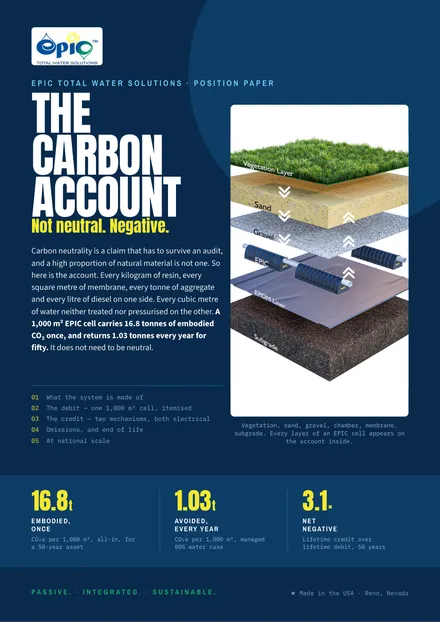
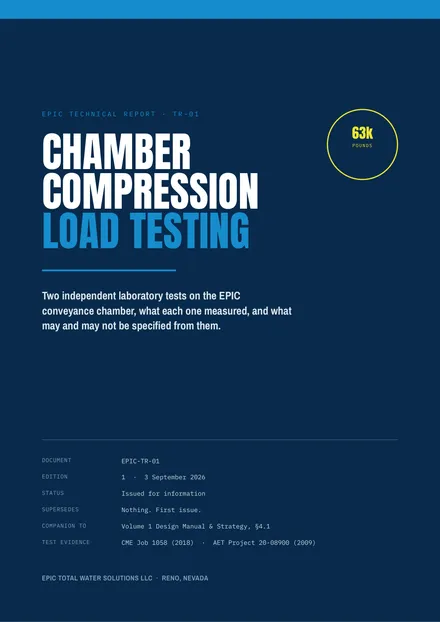
Chamber Compression Load Testing
The independent laboratory load tests on the EPIC chamber and their measured results.
On request11 pages
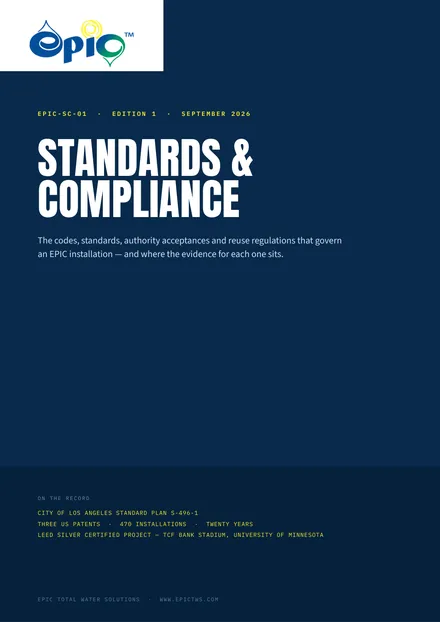
Standards and Compliance
The approvals and standards register: what EPIC is tested and certified against.
On request9 pages
Sand and Gravel Specification
Acceptance criteria, grading envelope and the column test that qualifies a candidate sand.
On request26 pages
Working on a project? Send us the drawings, the bill of quantities or the question.
Talk to usPublished by EPIC Total Water Solutions LLC, Reno, Nevada. Issued in the Middle East and North Africa by Xpitrade General Trading LLC.